One Conference, Many Perspectives on LLMs

The STAF conference is quite unique among software-related conferences. It is a federated conference with many different co-located events occurring in parallel, including conferences, workshops, and contests. This format is not entirely unusual, since many other conferences also support co-located events. Still, these events typically share a common topic and attract a similar community, while STAF enables connections between related communities that are not often brought together in the same place, even when they share interests.
In 2026, the event was held in Rennes, France, from June 30 to July 3. It was interesting to see this mix of communities and points of view across software development and language engineering, distributed among three full conferences (SLE, ECMFA, and ICGT) and five workshops. ICGT focused on graph transformation. While I’m not a specialist in GT, it’s valuable to review trends and tendencies in the area. When it comes to software/systems/languages engineering, while SLE provided an interesting view of language engineering for the years to come, the ECMFA (where I presented a paper) offered an interesting mix of model-driven systems engineering and new applications.
While this combination of research perspectives may sometimes create a certain cacophony, I was interested precisely in this kind of “confusion” and in seeing how different people were working with LLMs in software and systems engineering. After all, over the last three to five years, we have been living in a world disrupted by an expanding set of tools based on this technology. From coding agents to (semi-)autonomous designers and research assistants, LLM-powered tooling is everywhere, for both better and worse. A federated conference such as STAF looks like a promising place to understand how different communities interpret this transformation.
The ECMFA program, including my own presentation, featured many interesting studies exploring the potential of LLMs to automate and improve engineering activities. These included creating metamodels, supporting model transformations, and providing intelligent live assistance to engineers. Connecting cutting-edge research with real-world applications seems like the perfect description of the ECMFA program.
SLE was obviously about languages, but with fewer presentations on large language models. One of the core ideas behind engineering new languages is to help domain experts handle their daily tasks through an appropriate interface at the right level of abstraction. This means that LLMs may have little or no exposure to these languages, since they are often absent from their training data. The question, then, is whether this necessarily prevents LLMs from understanding and using these languages, including less common general-purpose ones. A paper presented at the conference by David Delgado investigated this question and reported interesting findings along these lines, which made me think about which languages I should rely on when using LLMs in daily programming tasks.
SLE also hosted an excellent panel discussing the future of language engineering in a world increasingly dominated by LLM-powered agents. It offered several interesting insights.
Among the workshops, I was naturally interested in LLM4SE, but also ICMM. While the former focused on the use of LLMs across different aspects of software engineering, the latter focused on discussions around model management. In both cases, my personal highlights were the invited keynotes. Ralf Lämmel gave a great overview of his experience using LLM assistants to build ontologies step by step, with plenty of examples and thoughtful experiments. At ICMM, Johan Cederbladh delivered a keynote about his experience at Volvo CE and the lessons learned from applying MBSE in such a large organization.
The conference was not only about LLMs, of course. Several other interesting topics also caught my attention, including digital twins (an increasingly present concept, despite the lack of a shared definition), software quality, and requirements engineering. Still, given my current research interests, I believe it is unavoidable to reflect on the changes brought by the rise of LLM-powered applications across almost every aspect of software and systems engineering. There may be no better place to think about these changes than within a federation of communities, all interested in advancing science and its applications.
I intend to keep exploring this intersection: how different software-engineering communities understand, adopt, and shape the growing role of LLM-powered tools.
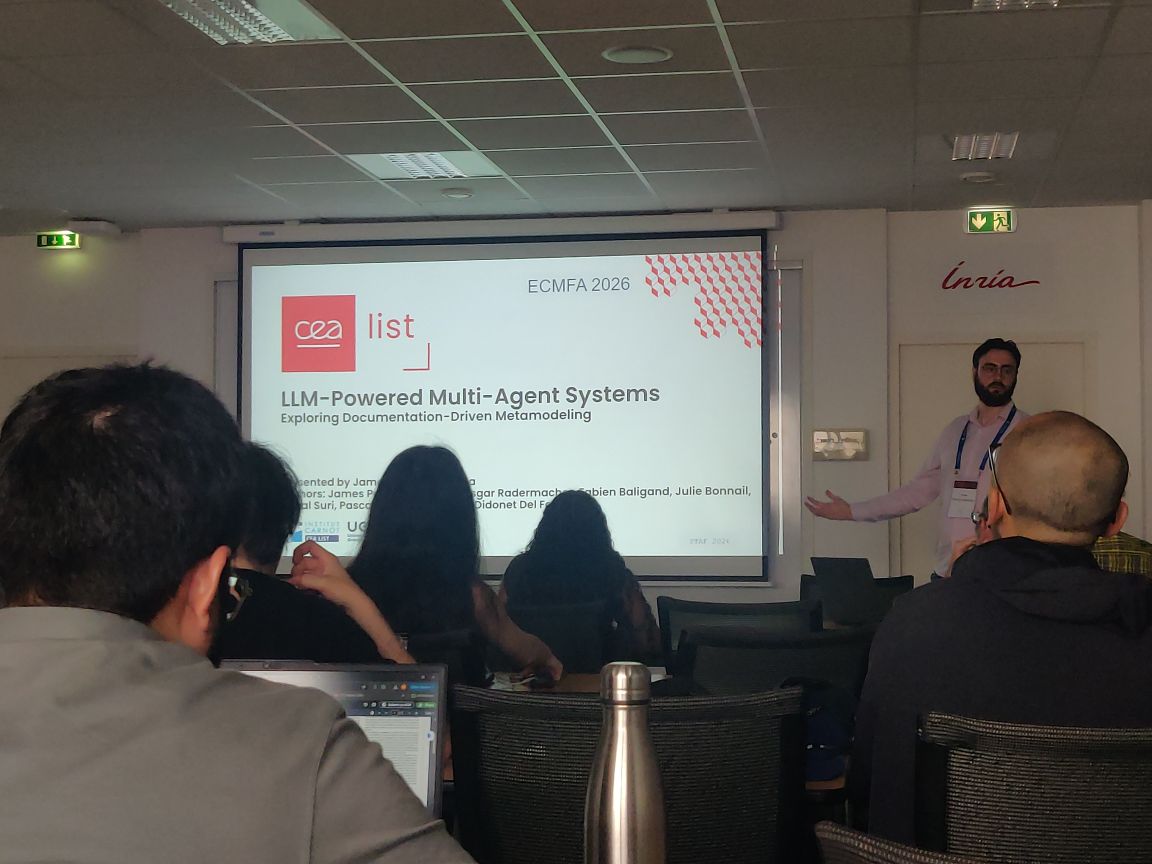
Presenting the paper at ECMFA 2026
Visit the conference website at https://conf.researchr.org/home/staf-2026.
Here is the slide deck from my presentation on ECMFA 2026 for those curious about it.